Most DND campaign settings are worlds filled with magic. How these worlds come about as well as the the origin of a specific spellcasters magic can vary in a number of different ways. Magic comes from many sources; some like Wizards, Bards, and Artificers spend their whole lives in the study of the Arcane arts. Others receive their magic as a gift from the divine, like Clerics, Paladins, and Warlocks. There are also those who gain their magic from nature or old traditions such as Druids and Rangers, and we must not forget those with the Natural ability to cast magic know as Sorcerers. No matter what its origin magic will always be an important part of DND, but since it’s not simple system to learn, you are probably wondering how you can cast spells. Don’t worry, you are about to learn.
Casting a spell is similar in many ways to firing a gun. Think of spell slots as unused ammunition and spell levels as the size of the ammunition. Depending on your character level you will have a limited number of certain levels spell slots and you can run out.
Spells range between level 0 and level 9, and all spell except Cantrips (level 0 spells) need a spell slot of similar or higher level to be cast.
When low level spells are cast by using higher level slots they gain additional effects that scales for every additional level higher.
All classes get their expended spells slots back during a long rest except Warlocks who get theirs back during a short rest.
In the game of Dungeons of Dragons, there are 8 different types or schools of magic. All magic can fit into one of these 8 schools. The Magic schools are as followed;
Abjuration: Prevents or reverses harmful effects.
Conjuration: Transports creatures or objects.
Divination: Reveals information.
Enchantment: Influences minds.
Evocation: channels energy to create effects that are often destructive.
Illusion: Deceives the mind or senses .
Necromancy: Manipulates life and death.
Transmutation: Transforms creatures or objects.
When addition content adds a new type of magic such as Biomancy they are not actual new schools with its own spells but rather is more of a subclass that features spells of already exiting classes, for example, the spell “False Life” is a Necromancy spell but in the “Heliana’s Guide to Monster Hunting” book, the spell received the Biomancy spell tag making it to be considered a Biomancy spell if needed.
All spells require between 1-3 components to be able to cast. If a spellcaster is missing one or more components that are listed in the spells description, the spellcaster won’t be able to cast the spell. The spells description will tell you which of the following components are needed to cast the spell;
Verbal (V): The spell requires your character to speak to activate this spell.
Somatic (S): The spell requires your character to use their hands and gesture in casting the spell.
Material (M): The spell requires your character to use a particular material stated in the spells description. the spell will specify if it will consume the Material, if it doesn’t and if the spell doesn’t specify cost of the Material, you can use a Component Pouch or an Arcane Focus instead.
A Component Pouch is watertight and with compartments that are assumed to hold all the free (unspecified cost) components for your spells.
A Arcane Focus or Spellcasting Focus is a specified object that a spellcaster can use to cast spells instead of using free (unspecified cost) components. Each class has their own Arcane Focuses they can use and depending on the subclass can gain more.
During combat you can only expend one spell slot per turn so you can not cast multiple spells per turn.
In addition to this most spell have casting time showing how long they take to cast, the following are some some examples, ranging from quickest to slowest;
Reaction
Bonus action
Action
(?) minutes
(?) hours
Spells that have casting time of reactions and/or some spells that have casting time of bonus action, will have a trigger or condition that must be met before casting that is stated in the spells description.
When casting longer spells you need to commit to the spell and be uninterrupted in its casting for each of your turns.
Some spells have the ritual tags, meaning they can be cast normally or be cast as a Ritual, the Ritual version takes an additional ten minutes to cast but does not consume a spell slot.
Some spells and other effects require concentration for their effects to remain active or in the case of Ritual casting and the casting for longer spells, to keep the casting going. You must hold concentration on the spell for its duration. you can end your concentration and the spell you are concentrating on at any time (no action required). Concentration can also be broken in the following ways;
Using a different spell or effect that requires concentration.
When taking damage you must make a Constitution saving throw to maintain concentration, the number you must roll must be higher than the save which is equal to ten or half the damage taken (rounded down), whichever number is higher, up to a maximum save of 30.
if your character is incapacitated or dead they loose concentration.
If a spell does not have a concentration requirement, the spells duration is either instantaneous (meaning the effects starts and ends the turn it is casted) or over a specified time span.
Each spell has a range to which the spell can be cast to. From closest to furthest;
Self
Touch
Specified distance
If the spell has movable effects, they are not restricted by its range unless otherwise stated.
A typical spell requires the caster to pick one or more targets to be affected by the spell. The spell description specifies what can be targeted. The Caster must have a clear path to the target and the target must not be behind total cover. If the spell targets a creature of your choice, you can cast the spell on your self unless otherwise stated.
Unless the spell has perceptible effect or the spell description say’s otherwise, the target is unaware that they have been targeted for a spell.
Some targets are unaffected by some effects. If you cast a spell on one of these invalid targets not only will the target be unaffected but you will also waste a spell slot. You are not made aware that the target is Invalid.
Areas of effect or AoE for short originate from a point of cast and affects everyone in that area, the following image (from the Wizards of the Coast “Players Handbook” 2014) showcases the different types of AoE as well as the point of origin (Spheres and Emanation share the same point of origin, the only difference is that a Emanation centre’s on a creature or object and moves with said creature or object) ;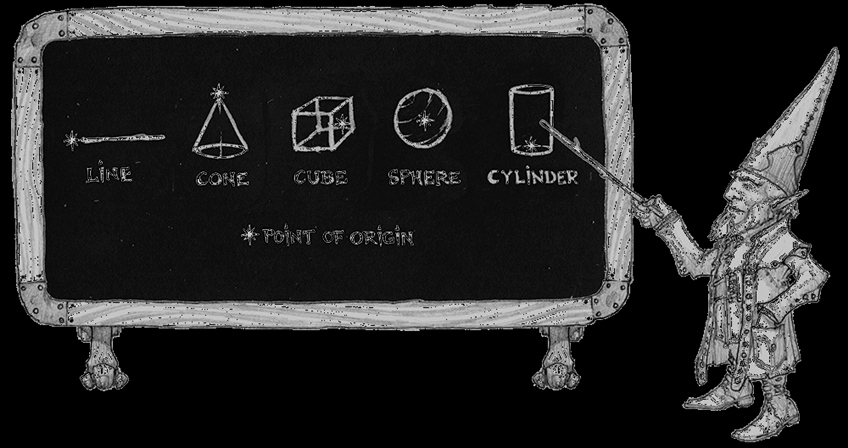
Many spells specify that a target makes a saving throw to avoid some or all of a spells effects. The spells specify the ability that the targets uses for the save and what happens on success or failure. The following is the calculation needed for the DC for your Spells;
Spell save DC = 8 + your spellcasting ability modifier + your proficiency bonus.
Some spell require the caster to make an attack roll to determine whether the spell hits a target. Here is the calculation for the attack modifier for your spells;
Spell attack modifier = your spellcasting ability modifier + your proficiency bonus.
The effects of different spells combine together for their durations. In contrast the effect of the same spell cast multiple times don’t combine. Instead, the effects of the spell casted at the higher level or the most recent spells, if they are the same level, are applied.